
Rhodes ChromavsRhodes Chroma Polaris
Summary
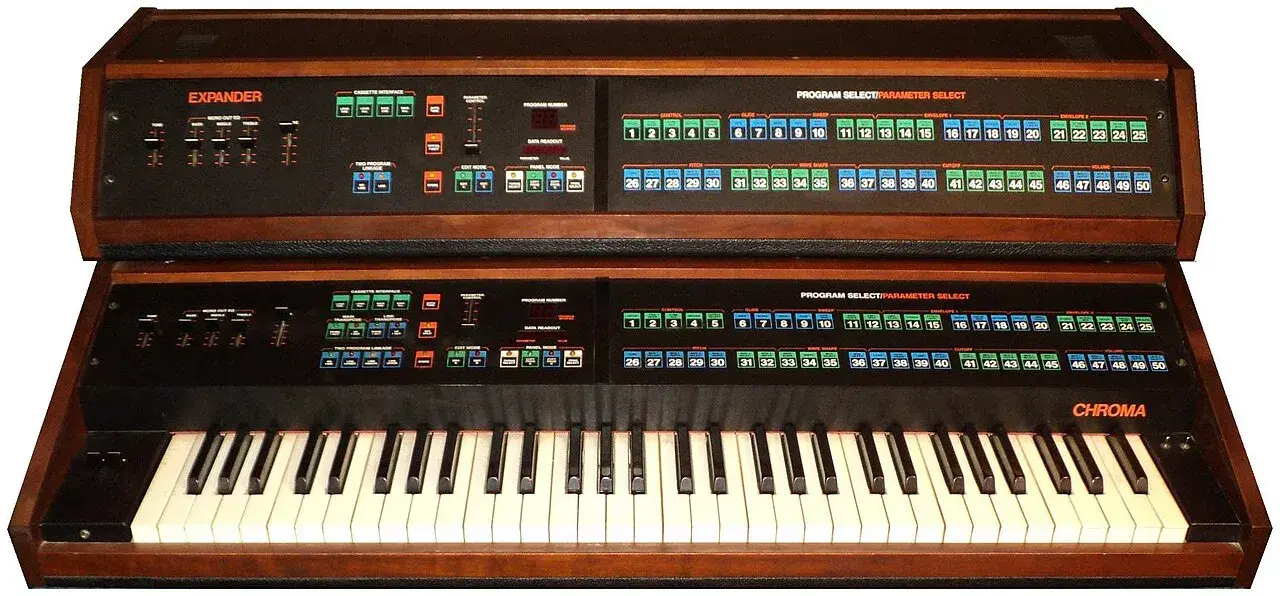
Rhodes Chroma and Rhodes Chroma Polaris: 2 Rhodes synth onlys compared side by side. They differ on 9 of 12 compared specifications.
| 2 items | Rhodes ChromaLegacy since 1984View details → | Rhodes Chroma PolarisLegacyView details → |
|---|---|---|
| General | ||
| Manufacturer | Rhodes | Rhodes |
| Status | Legacy | Legacy |
| Released | 1982 | 1984 |
| Sound engine | ||
| Engine | Analogue | Analogue |
| Voices | 16 | 6 |
| Polyphony | 16 voices, or 8 with channels paired | 6 voices |
| Oscillators | 16 VCOs (one per channel), variable sawtooth/pulse | 2 VCOs per voice, sawtooth and pulse with PWM |
| Filter | CEM3350 VCF per channel, low- or high-pass; paired channels give 24dB, band-pass and notch modes | 4-pole resonant low-pass (CEM3372) |
| Multi-timbral parts | 2 | — |
| Sequencer | None (Apple II interface and software available) | Simple real-time/step sequencer |
| Keyboard | ||
| Keys | 64 | 61 |
| Aftertouch | None | — |
| Keybed | 64 weighted, levered wooden keys with velocity; optional polyphonic pressure sensor (rarely fitted) | 61 keys with velocity |
| Format | ||
| Format | Keyboard | Keyboard |
| Features | Split and layer, 50 program memories, Cassette interface, 25-pin computer/Expander port, Membrane panel with tactile feedback, MIDI by third-party retrofit only | 132 patch memories, MIDI, Sequencer sync in/out, Cassette interface, Chroma interface connector |
| Connections | ||
| CV / Gate | No | No |
| Size & weight | ||
| Weight | — | 19 kg |
Key differences
- Keys: Chroma – 64 Chroma Polaris – 61
- Voices: Chroma – 16 Chroma Polaris – 6
- Released: Chroma – 1982 Chroma Polaris – 1984
- Polyphony: Chroma – 16 voices, or 8 with channels paired Chroma Polaris – 6 voices
- Oscillators: Chroma – 16 VCOs (one per channel), variable sawtooth/pulse Chroma Polaris – 2 VCOs per voice, sawtooth and pulse with PWM
- Filter: Chroma – CEM3350 VCF per channel, low- or high-pass; paired channels give 24dB, band-pass and notch modes Chroma Polaris – 4-pole resonant low-pass (CEM3372)
Both are the same on engine (Analogue).