
Nord Lead A1
Current
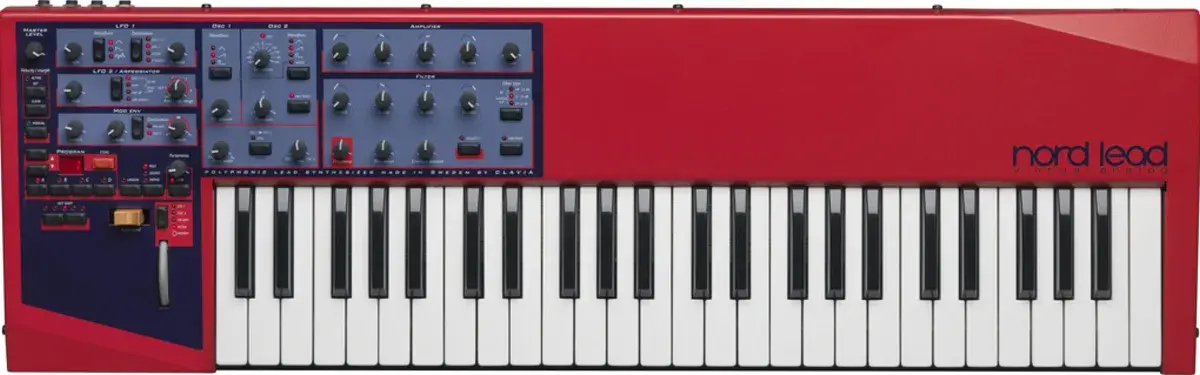
Nord's current virtual analogue: a 26-voice, four-part engine with simplified ADR envelopes and an 'oscillator configuration' knob that turns one waveform into sync, FM, AM or detuned stacks without routing anything. The filters include Mini-style ladder and TB-303 diode models, and every part gets its own effect, delay, reverb and output.
Specifications
General
- Manufacturer
- Nord
- Status
- Current
Sound engine
- Engine
- Analogue modelling
- Voices
- 26
- Polyphony
- 26 voices
- Oscillators
- 47 waveforms (analogue, extended analogue, pulse, additive, FM, formant) with 8 oscillator configurations
- Filter
- Multimode: 12/24 dB low-pass, band-pass, high-pass, Ladder M and Ladder TB models, with filter distortion
- Multi-timbral parts
- 4
- Effects
- Flanger, Phaser, Ring modulator, Chorus, Ensemble, Drive, Delay, Reverb
Keyboard
- Keys
- 49
- Key size
- Full
- Aftertouch
- None
Format
- Format
- Keyboard
- Motorised knobs
- No
- Features
- Pitch Stick, Arpeggiator, Morph (velocity, wheel, pedal), Mutator, 'Like' patch variations, Multi-Focus editing of all four slots, 4 audio outputs, Master Clock with tap tempo
Connections
- MIDI ports
- DIN in, DIN out, USB
- CV / Gate
- No
Size & weight
- Dimensions (W × D × H)
- 802 × 260 × 92 mm
- Weight
- 4.85 kg
Featured in
Sleeve notes · History
A short history of the synthesiser
From a 200-tonne dynamo to motorised knobs: the synths that changed things, in date order, with what each one added and what the jargon (voltage control, FM, wavetables, virtual analogue) actually means.
Sleeve notes · Listening
30 famous synth hooks and the synths that played them
From 'Jump' to 'Thriller' to 'Levels': the synth parts everyone knows, the instrument behind each one, where it sits in synth history and which plug-ins and keyboards get you the sound today.
Sleeve notes · Songwriting
10 songs you might not know who wrote
From 'Thriller' to 'Umbrella': the songwriters behind records you know by heart and the musicians hiding in the credits.
Sleeve notes · Songwriting
Covers that buried the original
Ten songs where the famous version is not the first one: who had it first, who took it over and what changed in between. Both recordings on every card, so you can hear what the cover did.