
Arturia ARP 2600 V3vsArturia Synthi V
Summary
Arturia ARP 2600 V3 and Arturia Synthi V: 2 Arturia software synths compared side by side. They differ on 9 of 11 compared specifications.
| 2 items | Arturia ARP 2600 V3CurrentView details → | Arturia Synthi VCurrentView details → |
|---|---|---|
| General | ||
| Manufacturer | Arturia | Arturia |
| Status | Current | Current |
| Released | 2016 | 2019 |
| Engine | ||
| Synth type | Analogue modelling | Analogue modelling |
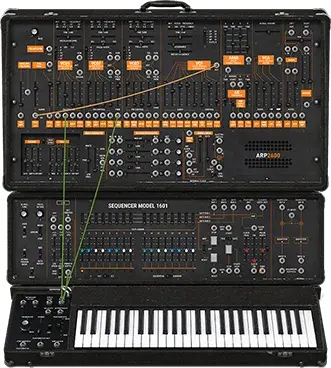
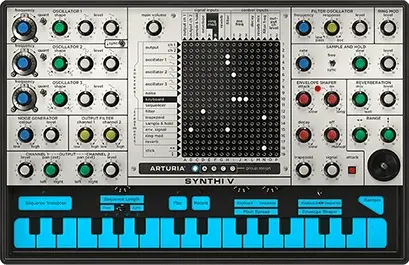
| Emulates | ARP 2600 (1971) | EMS Synthi AKS / VCS3 (1972) |
| Voices | 32 | 4 |
| Polyphony | 2 to 32 voices, with unison | Up to 4 voices |
| Oscillators | 3 VCOs, noise, ring modulator, sample and hold | 3 VCOs, noise, ring modulator |
| Filter | 24 dB resonant low-pass plus ARP 2500 12 dB multimode | 18 dB resonant low-pass |
| Sequencer | Modelled ARP 1601 step sequencer | Keyboard sequencer module, syncs to the DAW |
| Effects | Chorus, Delay, Reverb | Reverb, Phaser, Flanger, Chorus, Drive, Delay |
| Software | ||
| Plugin formats | VST2, VST3, AU, AAX | VST2, VST3, AU, AAX |
| Features | ||
| Features | Semi-modular patching, Standalone app, NKS | Pin-matrix patching, Joystick, Standalone app, NKS |
Key differences
- Voices: ARP 2600 V3 – 32 Synthi V – 4
- Released: ARP 2600 V3 – 2016 Synthi V – 2019
- Emulates: ARP 2600 V3 – ARP 2600 (1971) Synthi V – EMS Synthi AKS / VCS3 (1972)
- Polyphony: ARP 2600 V3 – 2 to 32 voices, with unison Synthi V – Up to 4 voices
- Oscillators: ARP 2600 V3 – 3 VCOs, noise, ring modulator, sample and hold Synthi V – 3 VCOs, noise, ring modulator
- Filter: ARP 2600 V3 – 24 dB resonant low-pass plus ARP 2500 12 dB multimode Synthi V – 18 dB resonant low-pass
Both are the same on synth type (Analogue modelling) and plugin formats (VST2, VST3, AU, AAX).