
Arturia DX7 VvsArturia Matrix-12 V2
Summary
Arturia DX7 V and Arturia Matrix-12 V2: 2 Arturia software synths compared side by side. They differ on 8 of 10 compared specifications.
Key differences
- Synth type: Digital (FM) on the DX7 V and Analogue modelling on the Matrix-12 V2.
- Voices: 32 on the DX7 V and 12 on the Matrix-12 V2.
- Released: 2017 on the DX7 V and 2016 on the Matrix-12 V2.
- Emulates: Yamaha DX7 (1983) on the DX7 V and Oberheim Matrix-12 (1985) on the Matrix-12 V2.
- Polyphony: 32 voices on the DX7 V and 12 voices on the Matrix-12 V2.
- Oscillators: 6 operators, 32 algorithms, 25 waveforms per operator on the DX7 V and 2 VCOs (triangle, saw, variable pulse); Osc 2 doubles as noise on the Matrix-12 V2.
Both are the same on plugin formats (VST2, VST3, AU, AAX).
| 2 items | 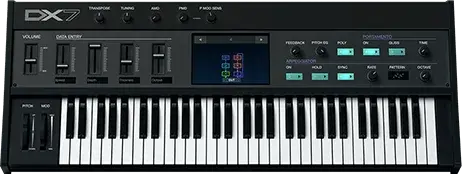 Arturia DX7 VCurrent | 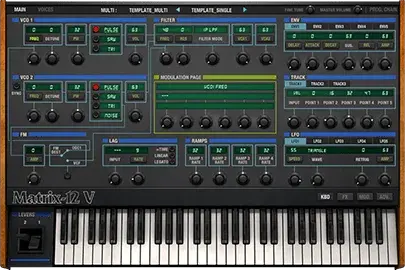 Arturia Matrix-12 V2Current |
|---|---|---|
| General | ||
| Manufacturer | Arturia | Arturia |
| Status | Current | Current |
| Released | 2017 | 2016 |
| Engine | ||
| Synth type | Digital (FM) | Analogue modelling |
| Emulates | Yamaha DX7 (1983) | Oberheim Matrix-12 (1985) |
| Voices | 32 | 12 |
| Polyphony | 32 voices | 12 voices |
| Oscillators | 6 operators, 32 algorithms, 25 waveforms per operator | 2 VCOs (triangle, saw, variable pulse); Osc 2 doubles as noise |
| Filter | Multimode filter per operator | 15-mode multimode (low-pass, high-pass, band-pass, notch, phase shift, combinations) |
| Sequencer | Step sequencer | — |
| Effects | Insert effects | Insert effects |
| Software | ||
| Plugin formats | VST2, VST3, AU, AAX | VST2, VST3, AU, AAX |
| Features | ||
| Features | DX7 SysEx import, Arpeggiator, Standalone app, NKS | Modulation matrix, Multi-timbral, Standalone app, NKS |