
Arturia Jun-6 VvsArturia Jup-8 V4
Summary
Arturia Jun-6 V and Arturia Jup-8 V4: 2 Arturia software synths compared side by side. They differ on 6 of 8 compared specifications.
Key differences
- Voices: 36 on the Jun-6 V and 16 on the Jup-8 V4.
- Emulates: Roland Juno-6 (1982) on the Jun-6 V and Roland Jupiter-8 (1981) on the Jup-8 V4.
- Polyphony: Up to 36 voices on the Jun-6 V and Up to 16 voices on the Jup-8 V4.
- Oscillators: 1 DCO per voice with sub-oscillator and noise, free-running phase on the Jun-6 V and 2 VCOs per voice with cross-modulation and sync on the Jup-8 V4.
- Filter: Modelled resonant low-pass plus high-pass on the Jun-6 V and Resonant low-pass VCF plus separate high-pass on the Jup-8 V4.
Both are the same on synth type (Analogue modelling) and plugin formats (VST2, VST3, AU, AAX).
| 2 items | 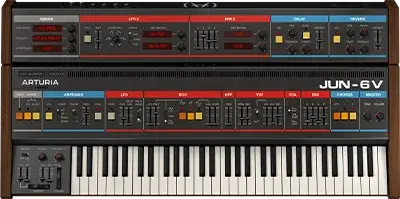 Arturia Jun-6 VCurrent | 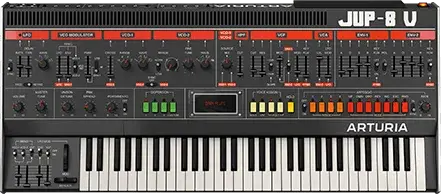 Arturia Jup-8 V4Current |
|---|---|---|
| General | ||
| Manufacturer | Arturia | Arturia |
| Status | Current | Current |
| Released | — | 2022 |
| Engine | ||
| Synth type | Analogue modelling | Analogue modelling |
| Emulates | Roland Juno-6 (1982) | Roland Jupiter-8 (1981) |
| Voices | 36 | 16 |
| Polyphony | Up to 36 voices | Up to 16 voices |
| Oscillators | 1 DCO per voice with sub-oscillator and noise, free-running phase | 2 VCOs per voice with cross-modulation and sync |
| Filter | Modelled resonant low-pass plus high-pass | Resonant low-pass VCF plus separate high-pass |
| Effects | Chorus, Delay, Reverb | — |
| Software | ||
| Plugin formats | VST2, VST3, AU, AAX | VST2, VST3, AU, AAX |
| Features | ||
| Features | Arpeggiator, Chord mode, Unison, Macro controls, Standalone app, NKS | Arpeggiator, Voice dispersion, Unison, Standalone app, NKS |