
Listening guide
30 famous synth hooks and the synths that played them
From 'Jump' to 'Thriller' to 'Levels': the synth parts everyone knows, the instrument behind each one, where it sits in synth history and which plug-ins and keyboards get you the sound today.
Updated 27 September 2026SynthesizersMIDI Keyboards
How to use this
Each card is a song you already know, with the synth part that makes it recognisable. It tells you what the hook is, which instrument played it and, under 'Get the sound', three things: where that instrument sits in our history of the synthesiser, which software recreates it and what hardware in the catalogue can do the job.
Where the credits are disputed we say so. Studio records from the 70s and 80s are often patchy, and several of these parts were layered from more than one synth.
Most cards have a Listen button that plays the song here. Every one is the official upload from the artist's, label's or broadcaster's own YouTube channel, and nothing loads from YouTube until you press it. 'Axel F' has no official upload yet, so it has no button.
The 1970s: modulars and the Minimoog
Early synth hooks are mostly monophonic: one note at a time, often gliding between them. The Moog modular and the Minimoog dominate.
1970
'Lucky Man'
Emerson, Lake & Palmer · Moog modular
- The closing solo
- Monophonic
- Portamento
The hook: Keith Emerson's gliding solo over the last minute of the song, improvised in one take on a Moog modular. Its swooping portamento (the pitch sliding between notes) made it one of the first synth parts most rock fans ever heard.
Official upload from Emerson, Lake and Palmer. Loads from YouTube when you press play, or watch it there ↗
Get the sound
On the synth history timeline: the Moog modular, the instrument that made voltage control practical.
In software: Arturia Modular V recreates the Moog modular, cables and all. For a simpler start, Arturia Mini V or u-he Diva with portamento turned up gets the same slide.
In hardware: any analogue or analogue-modelling mono synth with glide.
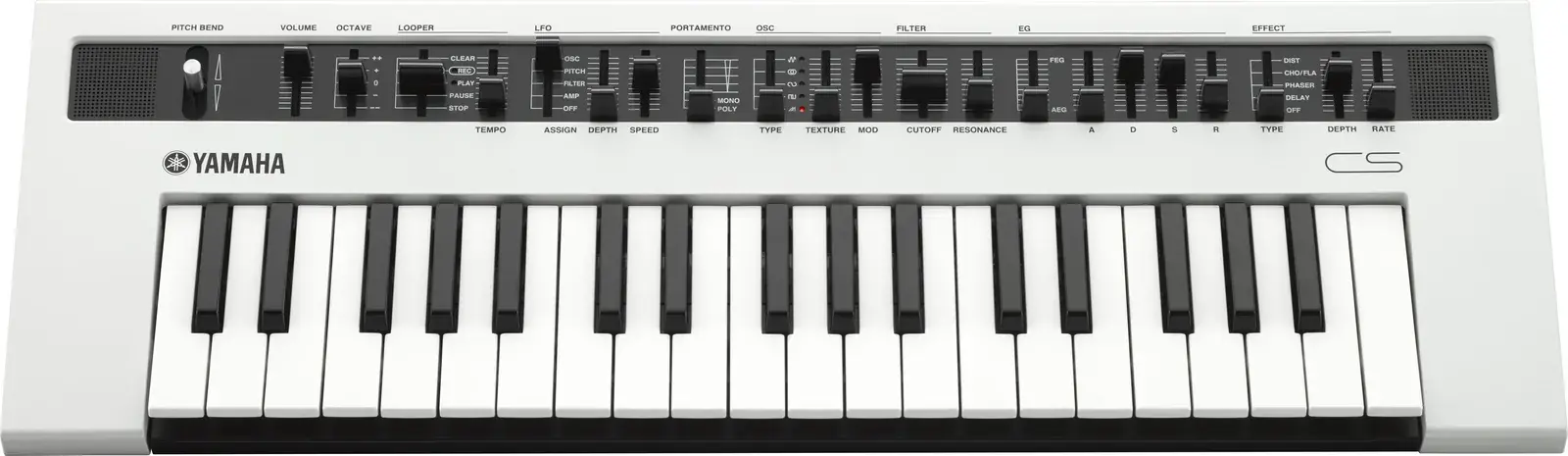
In the catalogue: Yamaha reface CS, Nord Lead A1
1972
'Popcorn'
Hot Butter · Moog modular
- The whole melody
- Staccato plucks
- Monophonic
The hook: The bouncing, plucky tune that made a Moog novelty record a worldwide hit. It is a short-decay patch: a square-ish wave with the filter envelope snapping shut on every note.
Official upload from INA Chansons. Loads from YouTube when you press play, or watch it there ↗
Get the sound
On the synth history timeline: the Moog modular.
In software: Arturia Modular V or Mini V. Any synth with a fast filter envelope will do it: keep the decay short and sustain at zero.
In the catalogue: Yamaha reface CS, Nord Lead A1
1973
'Chameleon'
Herbie Hancock · ARP Odyssey
- The bass line
- Duophonic
- Filter sweep
The hook: The fat, funky synth bass that opens 'Head Hunters' and runs for 15 minutes. Hancock played it on an ARP Odyssey, the compact sibling of the ARP 2600.
Official upload from HerbieHancockVEVO. Loads from YouTube when you press play, or watch it there ↗
Get the sound
On the synth history timeline: the Odyssey isn't on the timeline, but its bigger brother the ARP 2600 is, and the two share their oscillator and filter design.
In software: Korg Collection includes an ARP Odyssey plug-in, and Arturia ARP 2600 V gets very close.
In hardware: Korg's reissued ARP Odyssey, or any mono analogue synth with a resonant filter.
In the catalogue: Yamaha reface CS, Nord Lead A1
1974
'Autobahn'
Kraftwerk · Minimoog
- Bass and melody
- Monophonic
- Glide
The hook: The Minimoog bass and melody that carry Kraftwerk's 22-minute drive down the motorway, bright and bubbling, with the pitch sliding between notes.
Official upload from TopPop. Loads from YouTube when you press play, or watch it there ↗
Get the sound
On the synth history timeline: the Minimoog Model D, the template for the synth as we know it.
In software: Arturia Mini V, or u-he Diva's Minimoog-style oscillator and filter.
In hardware: Moog's reissued Minimoog Model D, or any three-oscillator mono synth.
In the catalogue: Yamaha reface CS, Nord Lead A1
1976
'Oxygène (Part IV)'
Jean-Michel Jarre · ARP 2600, EMS VCS3 and Eminent 310
- Lead melody
- Phased string pad
- Recorded at home
The hook: The whistling lead melody over a swirling pad. The lead was programmed on an ARP 2600; the pad is an Eminent 310 string machine and an EMS VCS3 run through a Small Stone phaser pedal, which gives it that swirl.
Official upload from JeanMichelJarreVEVO. Loads from YouTube when you press play, or watch it there ↗
Get the sound
In the catalogue: Yamaha reface CS, Nord Lead A1
1977
'I Feel Love'
Donna Summer · Moog modular
- Sequenced bass line
- Everything but the kick drum
- Delay
The hook: The pulsing, sequenced bass line that Brian Eno said would change club music for 15 years. Giorgio Moroder built the whole backing on a Moog modular apart from the kick drum, with a delay giving the bass its galloping double-note feel.
Official upload from DonnaSummerVEVO. Loads from YouTube when you press play, or watch it there ↗
Get the sound
On the synth history timeline: the Moog modular.
In software: Arturia Modular V or Mini V, driven by your DAW's sequencer or arpeggiator, with a tempo-synced delay on eighth-note triplets or a dotted eighth.
In hardware: any synth with a step sequencer or arpeggiator.
In the catalogue: Yamaha reface CS, Nord Lead A1
1979
'Cars'
Gary Numan · Minimoog and Polymoog
- The riff
- Polymoog 'Vox Humana' pad
- Monophonic lead
The hook: The chugging riff is a Minimoog. The glassy chords around it are the Polymoog's 'Vox Humana' preset, which Numan used on almost everything at the time.
Official upload from Beggars Banquet Records. Loads from YouTube when you press play, or watch it there ↗
Get the sound
On the synth history timeline: the Minimoog Model D. The Polymoog isn't on the timeline.
In software: Arturia Mini V for the riff. For the Polymoog chords, use a detuned-saw poly patch with a slow attack in any analogue emulation.
In the catalogue: Yamaha reface CS, Nord Lead A1
1981–1983: the polysynth takes over
Polyphonic synths with memory (Prophet-5, OB-X and OB-Xa, Jupiter-8) put synth chords and brass at the front of pop records, and the first digital instruments and samplers arrived.
1981
'In the Air Tonight'
Phil Collins · Sequential Prophet-5
- The chords
- Roland CR-78 drum machine
- Vocoder
The hook: The dark, slow-breathing chords that wait nearly four minutes for the drum fill. They're a Prophet-5, over a Roland CR-78 drum machine.
Official upload from Phil Collins. Loads from YouTube when you press play, or watch it there ↗
Get the sound
On the synth history timeline: the Prophet-5, the first polysynth with patch memory.
In software: Arturia Prophet-5 V or u-he Repro-5.
In hardware: Sequential's reissued Prophet-5, or any analogue poly.
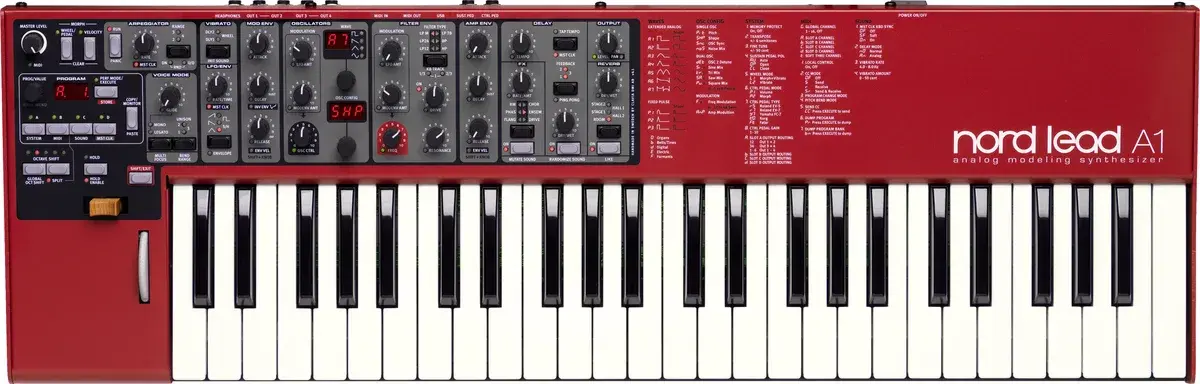
In the catalogue: Nord Lead A1, Melbourne Instruments NINA
1981
'Chariots of Fire'
Vangelis · Yamaha CS-80
- The main theme
- Brass patch
- Ribbon and aftertouch
The hook: The slow, soaring brass theme over a pulsing piano. Vangelis played it on the CS-80, leaning into the keys for polyphonic aftertouch to swell and bend single notes.
Official upload from VangelisVEVO. Loads from YouTube when you press play, or watch it there ↗
Get the sound
On the synth history timeline: the CS-80.
In software: Arturia CS-80 V. Play it with a keyboard that has aftertouch and map pressure to brightness and vibrato.
In hardware: a keyboard with aftertouch makes the biggest difference. The Montage M's AN-X engine models analogue brass and responds to aftertouch.
In the catalogue: Yamaha MONTAGE M6
1981
'Tom Sawyer'
Rush · Oberheim OB-X and Minimoog
- The growling intro
- Unison mode
- Minimoog lead
The hook: The ripping growl at the top of the song is an OB-X in unison mode, all eight voices on one note. Each voice's filter sweeps at a slightly different rate, which is what makes it snarl. Geddy Lee played the melody on a Minimoog at the same time.
Official upload from RushVEVO. Loads from YouTube when you press play, or watch it there ↗
Get the sound
On the synth history timeline: the OB-X's successor, the OB-Xa, and the Minimoog Model D.
In software: Arturia OB-Xa V (switch on unison), or the free OB-Xd, which is modelled on the OB-X. Arturia Mini V for the lead.
In hardware: a polysynth with a unison mode.
In the catalogue: Nord Lead A1, Melbourne Instruments NINA
1981
'Tainted Love'
Soft Cell · Synclavier and Korg Synthe-Bass
- Synclavier melody
- Korg bass
- The 'bink-bink' is a drum
The hook: The melody and stabs are a Synclavier, the bass a Korg Synthe-Bass. The famous 'bink-bink' is not a synth at all: it is a Synare electronic drum run through a delay unit.
Official upload from SoftCellVEVO. Loads from YouTube when you press play, or watch it there ↗
Get the sound
On the synth history timeline: the Synclavier II.
In software: Arturia Synclavier V. For the 'bink-bink', a short synth tom through a tempo-synced delay.
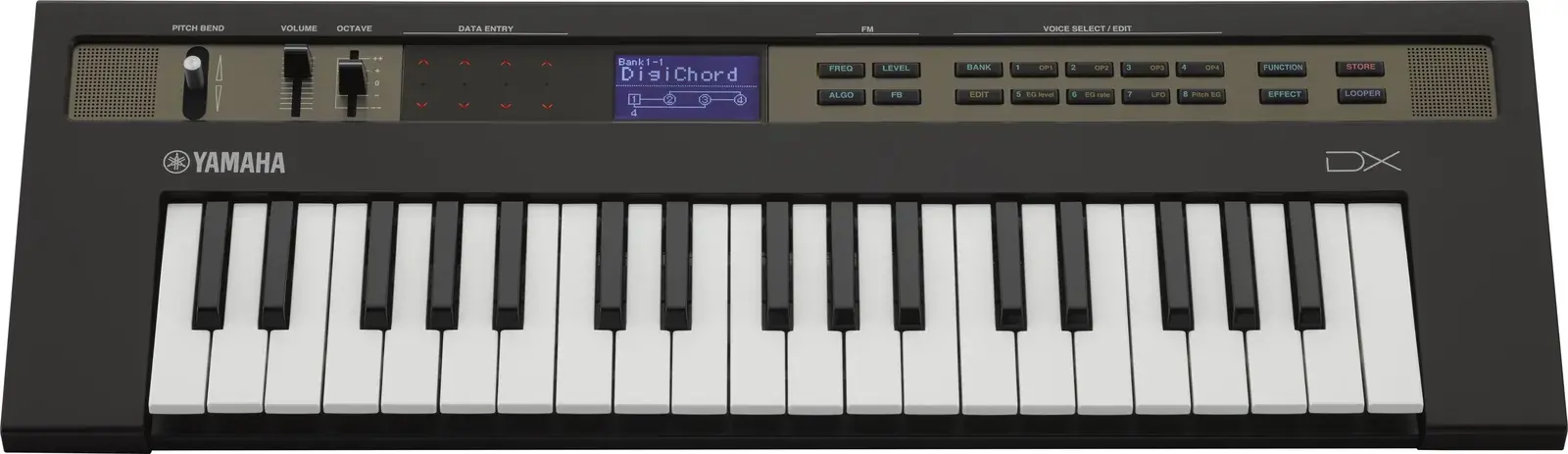
In the catalogue: Yamaha reface DX, Yamaha MONTAGE M6
1982
'Africa'
Toto · Yamaha CS-80 and GS1
- Brassy flute lead
- Kalimba riff
- Six layered takes
The hook: Two hooks. The breathy, brassy flute lead is a CS-80. The kalimba riff is a Yamaha GS1, the FM piano that came before the DX7, recorded six times with different rhythms and layered.
Official upload from TotoVEVO. Loads from YouTube when you press play, or watch it there ↗
Get the sound
In the catalogue: Yamaha reface DX, Yamaha MONTAGE M6
1982
'1999'
Prince · Oberheim OB-Xa
- Brass stabs
- Unison lead
- The Minneapolis sound
The hook: The fat, punchy synth-brass stabs where a horn section would usually be. Prince's OB-Xa is at the heart of the Minneapolis sound.
Official upload from Prince. Loads from YouTube when you press play, or watch it there ↗
Get the sound
On the synth history timeline: the OB-Xa.
In software: Arturia OB-Xa V, or the free OB-Xd.
In hardware: any analogue poly with a snappy filter envelope.
In the catalogue: Nord Lead A1, Melbourne Instruments NINA
1982
'Thriller'
Michael Jackson · ARP 2600, Jupiter-8 and Prophet-5
- Bass line
- Layered verse pads
- Many synths
The hook: The bass line is often credited to a Minimoog, but synth programmer Anthony Marinelli has said it was an ARP 2600. The verse pads layer a Roland Jupiter-8 with a Prophet-5.
Official upload from michaeljacksonVEVO. Loads from YouTube when you press play, or watch it there ↗
Get the sound
In the catalogue: Yamaha reface CS, Nord Lead A1
1983
'Beat It'
Michael Jackson · Synclavier II
- The opening gong
- A demo sound
- Digital FM
The hook: The ominous gong in the first seconds. It came almost straight from the Synclavier's demo disk.
Official upload from michaeljacksonVEVO. Loads from YouTube when you press play, or watch it there ↗
Get the sound
On the synth history timeline: the Synclavier II.
In software: Arturia Synclavier V. A metallic FM bell with a long release in any FM synth gets you most of the way.
In hardware: an FM synth.
In the catalogue: Yamaha reface DX, Yamaha MONTAGE M6
1983
'Sweet Dreams (Are Made of This)'
Eurythmics · Roland SH-101 and Oberheim OB-X
- Two parts, not one
- Sequenced bass
- OB-X strings
The hook: Keyboard players struggle with the riff because it is two parts. A drum machine triggers a sequence on a Roland SH-101, and Annie Lennox played a string sound on a borrowed OB-X over the top.
Official upload from EurythmicsVEVO. Loads from YouTube when you press play, or watch it there ↗
Get the sound
On the synth history timeline: the OB-X's successor, the OB-Xa. The SH-101 isn't on the timeline.
In software: Roland Cloud's SH-101 or TAL-BassLine-101 for the sequence, and Arturia OB-Xa V or OB-Xd for the strings.
In hardware: any mono synth with a sequencer for the bass, plus a poly for the strings.
In the catalogue: Nord Lead A1, Melbourne Instruments NINA
1983
'Blue Monday'
New Order · Moog Source and E-mu Emulator
- Sequenced bass
- Emulator choir
- Oberheim DMX drums
The hook: The chugging bass is a Moog Source, played by a sequencer Bernard Sumner built himself. The choir stabs come from an E-mu Emulator, and the famous kick-drum stutter is an Oberheim DMX.
Official upload from New Order. Loads from YouTube when you press play, or watch it there ↗
Get the sound
On the synth history timeline: the Source isn't on the timeline, but it is a Minimoog descendant (Minimoog Model D). For the Emulator, see sampling on the Fairlight CMI.
In software: Arturia Mini V for the bass, and Arturia Emulator II V for the choir.
In the catalogue: Yamaha reface CS, Nord Lead A1
1983
'Owner of a Lonely Heart'
Yes · Fairlight CMI
- Orchestra hit
- ORCH5
- Trevor Horn production
The hook: The huge orchestra 'hits' punching through the song. The sample is ORCH5 from the Fairlight library, a single orchestral chord that 80s pop and hip hop used everywhere after this.
Official upload from yesofficial. Loads from YouTube when you press play, or watch it there ↗
Get the sound
On the synth history timeline: the Fairlight CMI, the first sampler.
In software: Arturia CMI V includes the Fairlight library, orchestra hits included.
In hardware: any sample-based keyboard has an orchestra hit somewhere in its presets.
In the catalogue: Yamaha MONTAGE M6, Nord Wave 2
1984–1988: brass, samples and FM
By the mid-80s hooks were as likely to come from a sampler or an FM synth as an analogue poly, and layering two synths became standard studio practice.
1984
'Jump'
Van Halen · Oberheim OB-Xa
- The riff
- Brass-style patch
- Eddie Van Halen
The hook: The most famous synth riff in rock: big, bright, slightly out-of-phase brass chords from Eddie Van Halen's OB-Xa.
Official upload from Van Halen. Loads from YouTube when you press play, or watch it there ↗
Get the sound
On the synth history timeline: the OB-Xa.
In software: Arturia OB-Xa V, or the free OB-Xd. Start with two detuned saws per voice, a half-open filter and a little filter envelope.
In hardware: Oberheim's OB-X8, or any analogue poly with two oscillators per voice.
In the catalogue: Nord Lead A1, Melbourne Instruments NINA
1984
'Axel F'
Harold Faltermeyer · Roland Jupiter-8
- Saw lead
- Moog modular bass
- DX7 marimba
The hook: The 'Beverly Hills Cop' theme. The cheeky saw lead is a Jupiter-8, the bass a Moog modular, the chord stabs a Roland JX-3P, and the marimba a DX7.
Get the sound
On the synth history timeline: the Jupiter-8 isn't on the timeline; the bass is a Moog modular and the marimba a DX7.
In software: Arturia Jup-8 V or Roland Cloud's JUPITER-8 for the lead, Modular V for the bass and DX7 V or Dexed for the marimba.
In the catalogue: Nord Lead A1, Melbourne Instruments NINA, Yamaha reface DX
1985
'Take On Me'
a-ha · Roland Juno-60
- The riff
- Probably doubled with a DX7
- PPG Wave on other parts
The hook: The bright, bouncing riff is a Juno-60, most likely doubled with a DX7. The same recording uses a PPG Wave and a DX7 bass elsewhere.
Official upload from a-ha. Loads from YouTube when you press play, or watch it there ↗
Get the sound
On the synth history timeline: the Juno-60, with the DX7 and PPG Wave 2.
In software: Roland Cloud's JUNO-60, TAL-U-NO-LX or Arturia Jun-6 V. Layer a DX7 V or Dexed brass on top.
In the catalogue: Nord Lead A1, Melbourne Instruments NINA
1985
'Running Up That Hill'
Kate Bush · Fairlight CMI
- The cello-like riff
- Sampled
- Kate Bush
The hook: The sawing, cello-like riff that loops under the whole song. It came from Kate Bush's Fairlight, the sampler she built several albums around.
Official upload from KateBushMusic. Loads from YouTube when you press play, or watch it there ↗
Get the sound
On the synth history timeline: the Fairlight CMI.
In software: Arturia CMI V.
In the catalogue: Yamaha MONTAGE M6, Nord Wave 2
1986
'The Final Countdown'
Europe · Yamaha TX816 and Roland JX-8P
- The brass riff
- Written on a Korg Polysix
- Two synths layered
The hook: Joey Tempest wrote the riff on a Korg Polysix borrowed from keyboardist Mic Michaeli. On the record, Michaeli layered a brassy JX-8P patch with a factory sound from a Yamaha TX816, a rack of eight DX7s.
Official upload from EuropeVEVO. Loads from YouTube when you press play, or watch it there ↗
Get the sound
On the synth history timeline: the DX7 (the TX816 is eight of them in a rack).
In software: Arturia DX7 V or Dexed for the FM layer, and a brass patch in Arturia Jun-6 V or Korg Collection's Polysix.
In hardware: an FM synth plus an analogue-style poly.
In the catalogue: Yamaha reface DX, Yamaha MONTAGE M6
1986
'Sledgehammer'
Peter Gabriel · E-mu Emulator II
- Shakuhachi flute intro
- Sampled
- Pitch bend
The hook: The breathy shakuhachi flute that opens the song, played from a sample on an E-mu Emulator II.
Official upload from Peter Gabriel. Loads from YouTube when you press play, or watch it there ↗
Get the sound
On the synth history timeline: sampling starts with the Fairlight CMI. The Emulator was the cheaper sampler that followed it.
In software: Arturia Emulator II V includes the shakuhachi. Most sample libraries have one too.
In the catalogue: Yamaha MONTAGE M6, Nord Wave 2
1988
'Orinoco Flow'
Enya · Roland D-50
- Pizzicato strings
- 'Pizzagogo' preset
- Lots of reverb
The hook: The plucked-string melody is the D-50's factory preset 'Pizzagogo', tweaked, layered with real plucked samples and bathed in reverb.
Official upload from enyatv. Loads from YouTube when you press play, or watch it there ↗
Get the sound
On the synth history timeline: the D-50.
In software: Roland Cloud's D-50 includes 'Pizzagogo'. Any pizzicato string patch plus a long reverb gets close.
In hardware: a sample-based keyboard with a pizzicato preset.
In the catalogue: Yamaha MONTAGE M6, Nord Wave 2
1990s onwards: workstations, grooveboxes and plug-ins
House and hip hop found new uses for old presets and second-hand boxes, and by 2010 the biggest synth hooks were being made entirely in software.
1992
'Show Me Love'
Robin S · Korg M1
- Organ bass
- 'Organ 2' preset
- Stonebridge remix
The hook: The organ bass line that made house music's most famous remix. Stonebridge was clicking through the M1's presets looking for a bass and landed on 'Organ 2'. He called the result a pure accident.
Official upload from Spinnin' Records. Loads from YouTube when you press play, or watch it there ↗
Get the sound
On the synth history timeline: the M1.
In software: Korg Collection's M1 has 'Organ 2' exactly. Play it low and short.
In hardware: any workstation's organ or 'house organ' preset.
In the catalogue: Yamaha MONTAGE M6, Nord Wave 2
1992
'Nuthin' but a 'G' Thang'
Dr. Dre feat. Snoop Doggy Dogg · Minimoog
- The high whistle lead
- Portamento
- G-funk
The hook: The high, gliding 'G-funk whistle' lead that defined West Coast hip hop. It is a Minimoog: a pure, near-sine tone with plenty of portamento.
Official upload from Dr. Dre. Loads from YouTube when you press play, or watch it there ↗
Get the sound
On the synth history timeline: the Minimoog Model D.
In software: Arturia Mini V: one oscillator, filter closed down to take the edge off, glide up high.
In hardware: any mono synth with portamento.
In the catalogue: Yamaha reface CS, Nord Lead A1
1995
'Da Funk'
Daft Punk · Roland TB-303
- The lead riff
- Heavily distorted
- Resonant filter
The hook: The snarling, distorted lead line is a TB-303 pushed hard through distortion and a filter, a long way from the 303's usual squelch.
Official upload from Daft Punk. Loads from YouTube when you press play, or watch it there ↗
Get the sound
On the synth history timeline: the TB-303.
In software: Roland Cloud's TB-303 or AudioRealism ABL3, into a distortion plug-in.
In hardware: any mono synth with a resonant filter and glide.
In the catalogue: Yamaha reface CS, Nord Lead A1
2010
'Scary Monsters and Nice Sprites'
Skrillex · Native Instruments Massive
- Wavetable 'talking' bass
- LFO wobble
- Distortion
The hook: The screaming, 'talking' bass drop. It is widely credited to Native Instruments' Massive: an LFO sweeps the oscillator through a wavetable and heavy distortion does the rest.
Official upload from Skrillex. Loads from YouTube when you press play, or watch it there ↗
Get the sound
On the synth history timeline: software synths start with VST instruments, and wavetables with the PPG Wave 2. Serum is the wavetable synth most producers use for this sound today.
In software: NI Massive or Massive X, Xfer Serum, or the free Vital.
In hardware: a wavetable synth such as the Nord Wave 2 or the Montage M.
In the catalogue: Nord Wave 2, Yamaha MONTAGE M6
2011
'Levels'
Avicii · LennarDigital Sylenth1
- Supersaw lead
- Unison detune
- Sidechain pumping
The hook: The euphoric lead riff is a detuned 'supersaw': many sawtooth voices slightly out of tune with each other, ducking in time with the kick. It is usually credited to Sylenth1, the plug-in behind much of that era's big-room sound.
Official upload from AviciiOfficialVEVO. Loads from YouTube when you press play, or watch it there ↗
Get the sound
On the synth history timeline: software synths start with VST instruments. The supersaw itself comes from virtual analogue, so see the Nord Lead.
In software: Sylenth1, Serum or the free Vital. Use a saw with 6 to 8 unison voices, light detune, then chorus, reverb and sidechain compression from the kick.
In hardware: a virtual analogue with unison, such as the Nord Lead A1.
In the catalogue: Nord Lead A1, Yamaha MONTAGE M6
Building a hook toolkit
Most of the list is covered by a handful of software bundles:
- Arturia V Collection: Modular V, Mini V, ARP 2600 V, Synthi V, CS-80 V, Prophet-5 V, OB-Xa V, Jup-8 V, Jun-6 V, Synclavier V, CMI V, Emulator II V and DX7 V. That is about two-thirds of this guide in one purchase.
- Roland Cloud: Roland's own JUPITER-8, JUNO-60, SH-101, TB-303 and D-50.
- Korg Collection: M1, Polysix and ARP Odyssey.
- Free: Dexed (DX7), OB-Xd (Oberheim OB-X) and Vital (wavetable, for the Massive and Serum sounds).
- Modern plug-ins: Serum, Massive and Sylenth1 cover the 2010s sounds, and u-he Diva and Repro-5 cover classic analogue.
If you'd rather have hardware, three instruments cover most of the ground: an analogue-style mono synth for the leads and basses, an FM synth for the bells and DX7 sounds, and a workstation for the samples, organs and pizzicato.
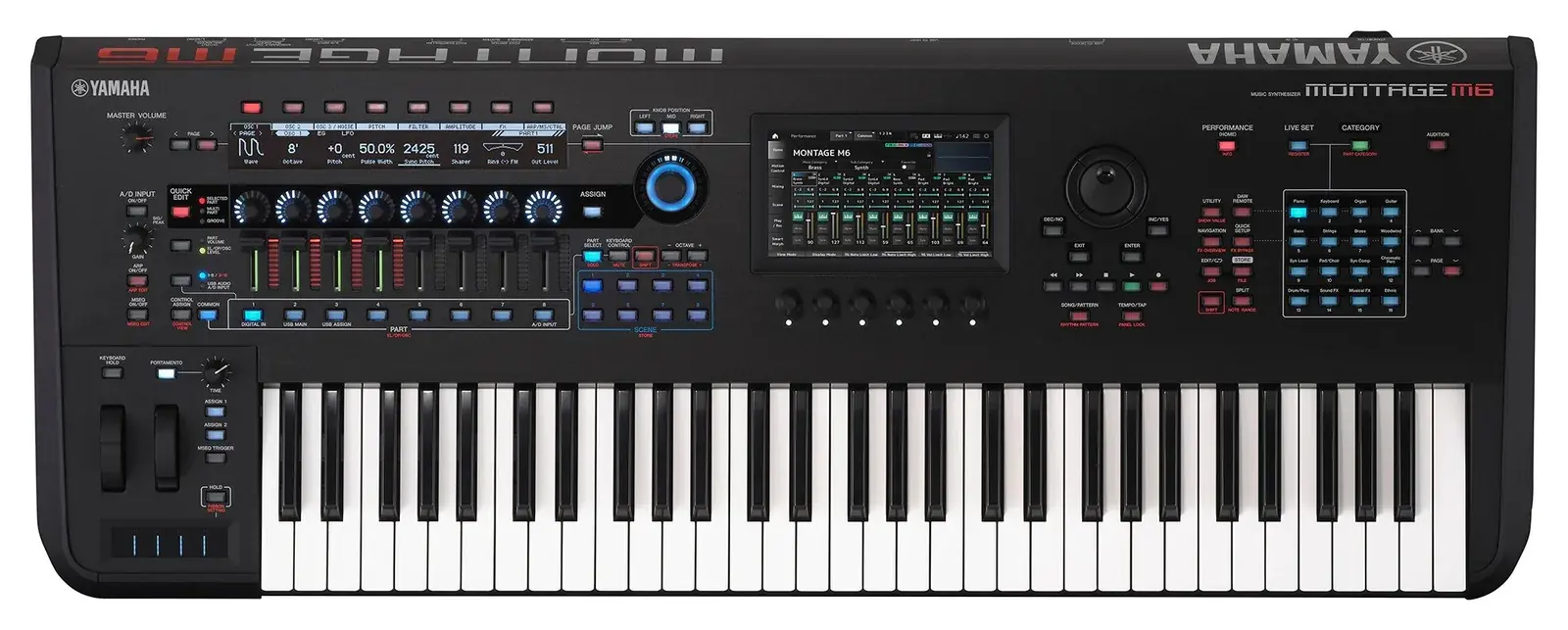
Yamaha
MONTAGE M6
Current- Engine
- Digital (sample, FM, virtual analogue)
- Keys
- 61
- Voices
- 256
- Key action
- Semi-weighted
—2023