
Listening guide
Is it a bird? Is it a plane? Is it a Rhodes?
How to tell a Rhodes from a Wurlitzer, a clavinet from a guitar and a Hammond from a Vox or a Farfisa by ear: what each one sounds like, what to listen for, and the songs and players that made them famous.
Updated 27 September 2026Stage KeyboardsOrgansSoftware Synths
"Ooh, is that a Rhodes?"
It started with a song my wife and I were listening to. "Ooh, is that a Rhodes?" she asked. It was a Hammond. I told her so, rather smugly.
Then it dawned on me that I had not always known either. At some point every one of us heard 'Riders on the Storm' and 'Light My Fire' and 'Superstition' and had no idea what was making those noises. We just knew we liked them. The names only arrived later, one record and one bit of gear-nerdery at a time.
So instead of being smug about it, I made her a playlist. A couple of songs for each instrument, a sentence on what to listen for, and the pairs that trip everybody up played side by side: Rhodes against Wurlitzer, Hammond against the cheaper combo organs, clavinet against a funky guitar. Now she is a whizz at it. This guide is that playlist, written down.
How to use this
There are six instruments here, in three families. The Rhodes and the Wurlitzer are electric pianos: hammers hitting metal, picked up like an electric guitar. The clavinet is the odd one out, a string struck from underneath, closer to an electric guitar than a piano. The Hammond, the Vox Continental and the Farfisa are organs: press a key and the note sounds for as long as you hold it, with no attack to speak of and no fade.
Each instrument has a short description of the sound, a list of what to listen for and a run of songs where you can hear it clearly. Most songs have a Listen button that plays the official upload from the artist's, label's or broadcaster's own YouTube channel. Nothing loads from YouTube until you press it. Where no official upload exists, the song is still worth finding, it just has no button.
The Rhodes
The Fender Rhodes (later just the Rhodes) was built from the 1960s to the early 1980s. Each key throws a hammer at a thin metal rod called a tine, which rings against a larger tone bar like a tuning fork, and a pickup turns that into a signal. The result is round, warm and bell-like, with a long sustain. The Suitcase model had a built-in stereo tremolo that pans the sound from speaker to speaker, and a lot of famous Rhodes parts have that gentle side-to-side wobble.
- A soft, glassy bell at the start of each note, then a warm, round tone that hangs in the air for a long time.
- Play it gently and it is mellow and almost vibraphone-like. Hit it hard and it 'barks': a growly, slightly distorted edge on the attack.
- Low notes are fat and woody. High notes chime.
- Often a slow wobble: the Suitcase's tremolo moving it left and right, or a phaser or chorus on top. It is the sound of 70s soft rock, jazz-funk and every neo-soul record since.
1971
'Riders on the Storm'
The Doors · Fender Rhodes
- Ray Manzarek
- The whole song
- Rain and thunder
Listen for: Ray Manzarek's Rhodes, drifting in and out over the rain. Listen to the little descending runs after each verse line: soft, liquid and sustaining, like drops of water. This is the sound to fix in your head as 'Rhodes'.
Official upload from The Doors. Loads from YouTube when you press play, or watch it there ↗
1972
'You Are the Sunshine of My Life'
Stevie Wonder · Fender Rhodes
- Stevie Wonder
- The intro
- Gentle touch
Listen for: The opening chords, played softly so the Rhodes stays sweet and bell-like with no bark at all. There is no official upload to play here, but it is on every Stevie Wonder collection and worth finding.
1977
'Just the Way You Are'
Billy Joel · Fender Rhodes
- Billy Joel
- The intro
- Phaser
Listen for: Billy Joel playing his own Rhodes, run through a phaser so the chords seem to shimmer and slowly turn. That swirl is an effect on the Rhodes, not the instrument itself, but it is the most famous Rhodes texture of the 70s.
Official upload from billyjoelVEVO. Loads from YouTube when you press play, or watch it there ↗
1980
'Just the Two of Us'
Grover Washington Jr. and Bill Withers · Fender Rhodes
- Richard Tee
- Under the vocal
- Lush chords
Listen for: Session player Richard Tee, under Bill Withers' vocal. Notice how thick and warm the chords are, and how they hang on underneath the voice rather than dying away. That long sustain is what separates a Rhodes from a Wurli.
Official upload from RHINO. Loads from YouTube when you press play, or watch it there ↗
The Wurlitzer
The Wurlitzer electric piano, which everyone calls a Wurli, uses a hammer on a flat steel reed rather than a tine, and it sounds it. Where the Rhodes is round and bell-like, the Wurli is reedy, nasal and a little honky, somewhere between a Rhodes and a harmonica. The notes are shorter, and when you dig in the tone breaks up into a buzzy, almost overdriven growl. Most models had a built-in tremolo that pulses the volume up and down rather than panning it.
- A quick, punchy attack and a shorter sustain: notes fade noticeably sooner than on a Rhodes.
- A reedy, slightly hollow, nasal tone, like a toy piano grown up and gone to the pub.
- Played hard, a gritty buzz on the front of the note.
- Tremolo that throbs in volume in the middle of the stereo picture, where a Rhodes Suitcase swings side to side.
1959
'What'd I Say'
Ray Charles · Wurlitzer electric piano
- Ray Charles
- The intro riff
- Played hard
Listen for: Ray Charles' opening riff, on the Wurlitzer he took on tour with him. Hear how bright and cutting it is, with a buzzy bite on every note. No Rhodes sounds like this.
Official upload from RHINO. Loads from YouTube when you press play, or watch it there ↗
1966
'Mercy, Mercy, Mercy'
Cannonball Adderley Quintet · Wurlitzer electric piano
- Joe Zawinul
- The theme
- Soul jazz
Listen for: Joe Zawinul's Wurli carrying the whole tune: warm, slightly smeared and churchy, with that nasal reediness in every chord. There is no official upload to play here, but it is easy to find and one of the great Wurli records.
1973
'Money'
Pink Floyd · Wurlitzer electric piano
- Richard Wright
- Stabs between the bass riff
- Effects
Listen for: Once the bass line gets going, listen for the chopped, slightly squelchy chords answering it. That is Rick Wright's Wurlitzer, run through effects. Even processed, it keeps its short, reedy snap.
Official upload from Pink Floyd. Loads from YouTube when you press play, or watch it there ↗
1974
'Dreamer'
Supertramp · Wurlitzer electric piano
- Roger Hodgson
- The whole song
- Bouncing riff
Listen for: The bouncing riff that runs through the entire song, on a Wurli Roger Hodgson wrote it on at home. Short, punchy, honky notes, a little distorted when he leans in. Play it straight after 'Just the Way You Are' and the difference between a Wurli and a Rhodes is obvious.
Official upload from Supertramp. Loads from YouTube when you press play, or watch it there ↗
Rhodes or Wurli?
This is the pair that catches out almost everyone, because they turn up in the same kinds of songs and are often played the same way. The quickest test is to wait for a held chord and listen to how it ends.
- Sustain: A Rhodes chord rings on and fades slowly. A Wurli chord dies away much sooner.
- Character: Rhodes is round, warm and bell-like. Wurli is reedy, nasal and a bit honky.
- Played hard: A Rhodes barks, a thick, rounded growl. A Wurli buzzes, a thinner, raspier grit.
- Wobble: A Rhodes Suitcase's tremolo moves side to side between speakers. A Wurli's tremolo pulses in volume in one place.
The clavinet
The Hohner Clavinet was designed as a sort of electric clavichord for playing Baroque music at home. Funk musicians had other ideas. Each key presses a small rubber tip onto a string, which is picked up like an electric guitar, and a strip of yarn damps the string the moment you let go. So every note is short, stringy and percussive, and a good clav part is really a drum part with pitches.
- Short, snappy, twangy notes that stop dead when the key is released.
- A bright, stringy, slightly metallic tone, a bit like a muted guitar or a harpsichord with attitude.
- Fast, interlocking rhythmic patterns, often with both hands: a bass figure under a chord stab.
- Very often through a wah-wah pedal or a phaser, which makes it quack.
1971
'Outa-Space'
Billy Preston · Hohner Clavinet
- Billy Preston
- The whole tune
- Wah-wah
Listen for: Billy Preston's clav through a wah-wah pedal, quacking and wailing like a funky guitar solo. It is the one most likely to fool you into thinking it is a guitar, so it is a good test.
Official upload from billyprestonmusic. Loads from YouTube when you press play, or watch it there ↗
1972
'Superstition'
Stevie Wonder · Hohner Clavinet
- Stevie Wonder
- The main riff
- Layered parts
Listen for: The clavinet riff everyone knows. On the record Stevie Wonder stacked several clav parts on top of each other, which is why it sounds so thick. This is a live performance from the German TV show Musikladen in 1974: watch his hands and you can see the riff is a keyboard part.
Official upload from Musikladen. Loads from YouTube when you press play, or watch it there ↗
1973
'Higher Ground'
Stevie Wonder · Hohner Clavinet
- Stevie Wonder
- The main riff
- Wah-wah
Listen for: A tighter, more urgent clav riff than 'Superstition', again with a wah. Listen for how every note is choked off short. Also live on Musikladen in 1974.
Official upload from Musikladen. Loads from YouTube when you press play, or watch it there ↗
1975
'Trampled Under Foot'
Led Zeppelin · Hohner Clavinet
- John Paul Jones
- Driving the song
- Wah-wah
Listen for: John Paul Jones playing a clav riff through a wah, locked with Jimmy Page's guitar. This is the best song on the list for hearing a clav and a guitar side by side: the clav is the more mechanical, evenly clipped one.
Official upload from Led Zeppelin. Loads from YouTube when you press play, or watch it there ↗
Clav or guitar?
A clav through a wah and a funk guitar through a wah can sound nearly identical in a busy mix. There are a few giveaways.
- No bends or slides: A guitarist bends strings and slides between notes. A clav can only jump from one exact pitch to another.
- Every note stops dead: The yarn damper cuts each note off the instant the key comes up. A guitar note rings on a bit, or gets choked with a slight scratch.
- No scratch and scrape: Funk guitar is full of muted 'chk' strums and pick noise. A clav has a hard click on the attack instead, the same on every note.
- Two hands at once: A clav often plays a low bass figure and a chord stab at the same time, which is awkward on one guitar.
- Range: A clav goes lower than a guitar's bottom string, so a riff that dips down into bass territory without changing tone is almost certainly a clav.
The Hammond
The Hammond organ makes its sound with spinning metal tonewheels, one per pitch, and you shape the tone with drawbars: sliders that mix in harmonics, a bit like mixing paint. The B-3, C-3 and their smaller siblings were designed for churches and homes and were adopted by jazz, gospel, soul and rock. What turns it from a pleasant organ into that sound is usually the Leslie speaker, a cabinet with a spinning horn and drum that throws the sound around the room.
- Notes that start instantly and hold at full volume for as long as the key is down. No decay at all: this alone tells you it is an organ and not a piano.
- A little 'tick' or click at the start of each note, and on many settings a bright percussive 'plink' on the attack.
- A thick, warm, full tone from low bass to screaming top, often with a growl of overdrive when played hard.
- The Leslie: a swirling, whooshing movement. Listen for the player switching from slow (chorale) to fast (tremolo) and hearing it speed up and slow down, like a helicopter taking off. Nothing else does that.
- Glissandos: the player's palm sliding up or down the keys in a big smear.
1962
'Green Onions'
Booker T. & the M.G.'s · Hammond M3
- Booker T. Jones
- The whole tune
- Bluesy and dry
Listen for: Booker T. Jones on a Hammond M3, with a biting, slightly percussive tone and not much swirl. It is a good one for hearing the organ's hold: the chords sit at full volume until he lets go. Then wait for the stabbing chords in the middle, where the sound fattens up.
Official upload from RHINO. Loads from YouTube when you press play, or watch it there ↗
1967
'A Whiter Shade of Pale'
Procol Harum · Hammond M-102
- Matthew Fisher
- The counter-melody
- Leslie
Listen for: Matthew Fisher playing a Bach-flavoured organ line, smooth and churchy, floating over the song on a slowly turning Leslie. This is the sound to fix in your head as 'Hammond'.
Official upload from FLY Records. Loads from YouTube when you press play, or watch it there ↗
1968
'Hush'
Deep Purple · Hammond organ
- Jon Lord
- The solo
- Overdriven
Listen for: Jon Lord pushing the Hammond into a gritty, distorted roar, with glissandos and a fast-spinning Leslie in his solo. Proof that the Hammond is a rock instrument as much as a church one.
Official upload from Deep Purple Official. Loads from YouTube when you press play, or watch it there ↗
Written by: Joe South, the Atlanta songwriter and session guitarist, who also wrote 'Games People Play' and 'Down in the Boondocks'. Deep Purple did not write their own breakthrough single: it was first recorded by Billy Joe Royal in 1967, and Kula Shaker took it back into the charts thirty years later.
Hear the versions
Joe South, 1968
Deep Purple, 1968
Kula Shaker, 1997
The combo organs: Vox Continental and Farfisa
In the early 60s a Hammond weighed as much as a small car. Bands wanted something they could put in the back of a van, and transistor 'combo' organs filled the gap. They make their tones electronically, have no tonewheels and usually no Leslie, and they sound thinner, buzzier and more synthetic than a Hammond. They are the sound of garage rock, 60s psychedelia and later new wave.
The Vox Continental, from the British company that made the AC30 amplifier, is the smoother and reedier of the two: breathy, a bit flute-like and hollow, with a soft attack. The Italian Farfisa is brighter and more nasal, a sharp, buzzy, slightly cheesy tone often with a quick vibrato. If a Vox sounds like a reed organ, a Farfisa sounds like a kazoo with ambition.
- Like a Hammond, notes hold at full volume, so you know it is an organ.
- No key click, no percussive plink and usually no Leslie swirl. The sound is flatter and more static.
- Thinner and brighter overall, with a buzzy, electronic edge rather than the Hammond's weight.
- A fast, shallow vibrato wobble is common on both.
1964
'The House of the Rising Sun'
The Animals · Vox Continental
- Alan Price
- The solo
- Live on TV
Listen for: Alan Price's organ solo: reedy, hollow and slightly wavering, with none of a Hammond's weight or swirl. This is The Animals live on The Ed Sullivan Show.
Official upload from The Ed Sullivan Show. Loads from YouTube when you press play, or watch it there ↗
1966
'96 Tears'
? and the Mysterians · Vox Continental
- Frank Rodriguez
- The riff
- Garage rock
Listen for: The two-note riff that runs through the whole song, thin, sharp and a little sour. Pure garage-band combo organ.
Official upload from QuestionMarkVEVO. Loads from YouTube when you press play, or watch it there ↗
1967
'Light My Fire'
The Doors · Vox Continental
- Ray Manzarek
- The intro and solo
- Baroque runs
Listen for: Ray Manzarek's intro and long solo on a Vox Continental. Put it next to 'A Whiter Shade of Pale' from the same year and hear the difference: brighter, thinner and more static, with no Leslie turning. The same player gave us the Rhodes on 'Riders on the Storm', which is exactly why this is so confusing.
Official upload from The Doors. Loads from YouTube when you press play, or watch it there ↗
1967
'Astronomy Domine'
Pink Floyd · Farfisa
- Richard Wright
- Behind the vocals
- Psychedelic
Listen for: Rick Wright's Farfisa, glassy and nasal, sustaining eerie chords under the vocals with a wobble of vibrato. Earlier the same Wright was on a Wurlitzer in 'Money'. Keyboard players really do get around.
Official upload from Pink Floyd. Loads from YouTube when you press play, or watch it there ↗
1978
'Rock Lobster'
The B-52's · Farfisa
- Kate Pierson
- Answering the guitar
- New wave
Listen for: Kate Pierson's Farfisa, thin, bright and buzzy, answering Ricky Wilson's surf guitar riff. Cheesy in the best way, and a completely different animal from a Hammond.
Official upload from RHINO. Loads from YouTube when you press play, or watch it there ↗
Hammond, Vox or Farfisa?
- Is it swirling, speeding up and slowing down? That is a Leslie, and it is almost certainly a Hammond.
- Is there a click or a plink at the start of each note? Hammond again. Combo organs start cleanly.
- Is it big, warm and heavy, with a growl when it gets loud? Hammond.
- Is it thinner, reedy and a little breathy? Probably a Vox.
- Is it brighter, sharper and buzzier, like it is being played through a comb? Probably a Farfisa.
How I trained her ear
This is roughly the order we did it in, a few songs at a time. It works just as well if you are training your own ears.
- Piano or organ? Start here, and only here. Play a held chord and ask: does it fade away, or does it stay at full volume until the player stops? Fading means an electric piano or a clav. Holding means an organ. That one question gets you halfway.
- Learn one reference song per instrument. 'Riders on the Storm' for the Rhodes, 'Dreamer' for the Wurli, 'Superstition' for the clav, 'A Whiter Shade of Pale' for the Hammond, 'Light My Fire' for the Vox. Play them until you could hum the keyboard part.
- Describe the sound in your own words. It does not matter if the words are not technical, as long as they stick.
- Play the confusing pairs back to back. 'Just the Way You Are' then 'Dreamer'. 'A Whiter Shade of Pale' then 'Light My Fire'. 'Trampled Under Foot' for the clav and guitar together. Switching between them is where the difference finally lands.
- Guess on the radio. Call out the instrument before you look it up. Being wrong is fine. Being wrong and then finding out why is how it sticks.
- Find a new song for each instrument yourself. Once you are spotting them in songs you did not learn them from, you have got it.
Get the sounds
You do not need a vintage Rhodes (heavy), a Wurlitzer (heavier than it looks), a clav (temperamental), a Hammond and a Leslie (bring friends) or a working Vox Continental (good luck) to play these sounds. Modern stage keyboards model all six, and most of them in one instrument.
- The Nord Electro and Nord Stage cover all six: Rhodes and Wurli models, clav, and Hammond, Vox and Farfisa organ models with a built-in Leslie simulation.
- Yamaha's small reface CP does Rhodes, Wurli and clav, and the reface YC does Hammond, Vox and Farfisa-style organs. Between them they make a very good ear-training kit.
- For a proper Hammond feel, with waterfall keys and real drawbars, look at the Hammond SK Pro or a Nord C2D, and read the organs and rotary speakers pages.
- In software, Arturia's V Collection includes a Rhodes (Stage-73 V), a Wurlitzer, a clavinet, a Hammond (B-3 V), a Vox Continental and a Farfisa, all playable from any MIDI keyboard.
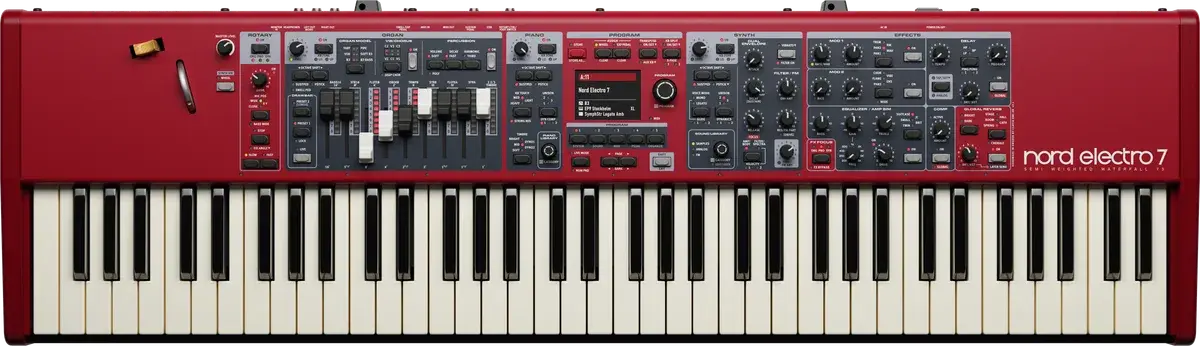
Nord
Electro 7 73
New- Keys
- 73
- Key action
- Semi-weighted
- Sections
- Piano, Electric piano, Organ, Synth, Sample playback
- Drawbars
- Physical
—2026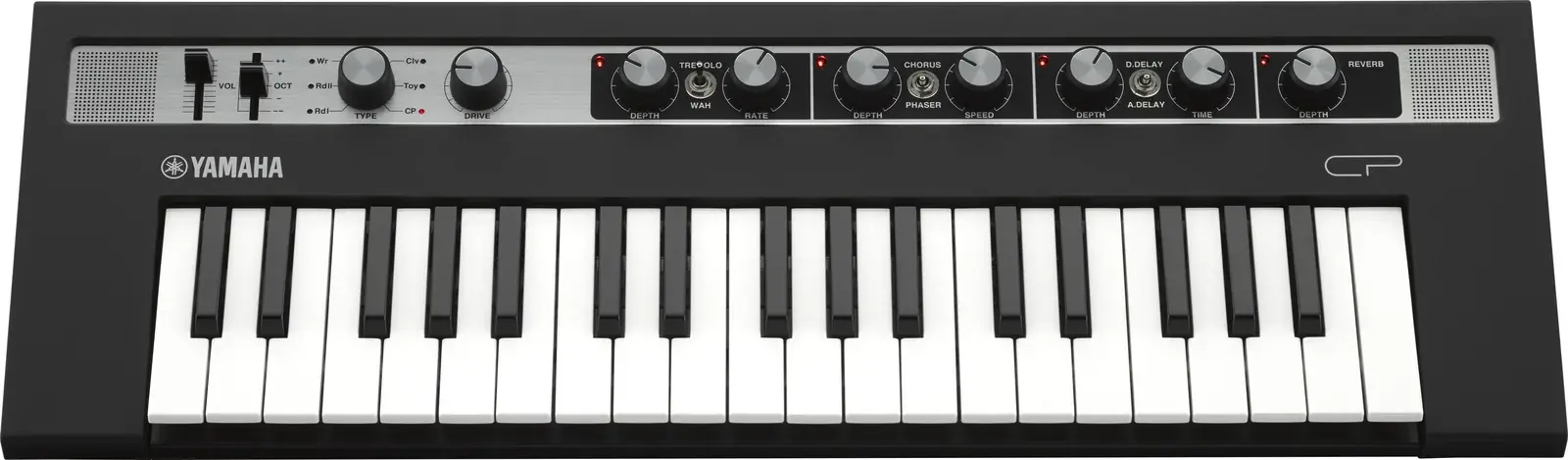
Yamaha
reface CP
Current- Engine
- Digital (electric piano modelling)
- Keys
- 37
- Voices
- 128
- Key action
- Synth-action
—2015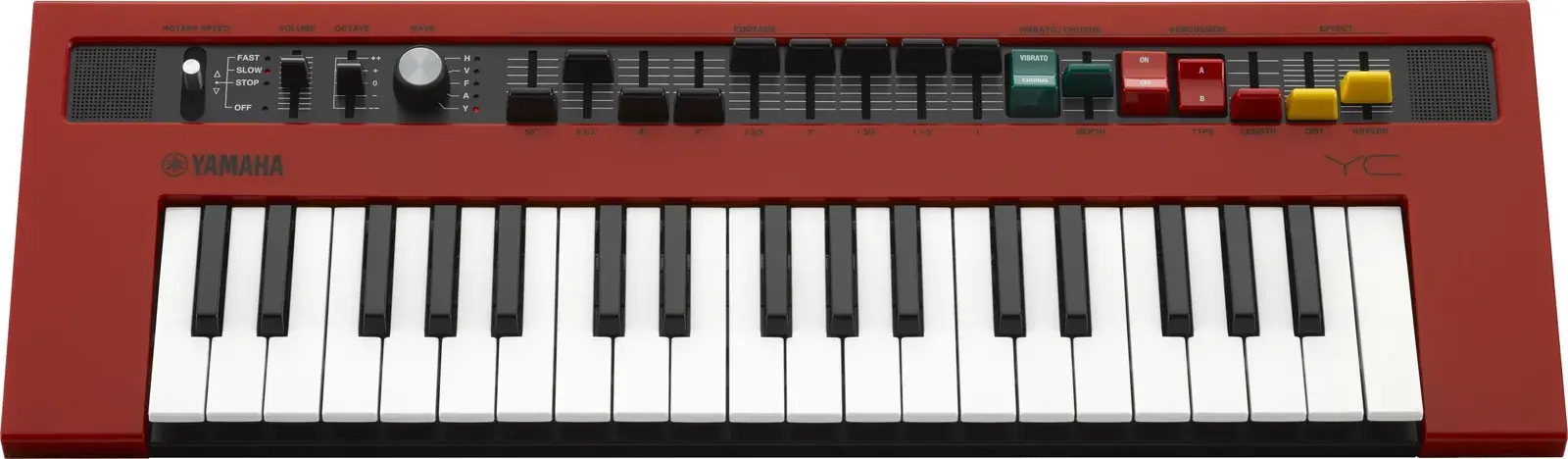
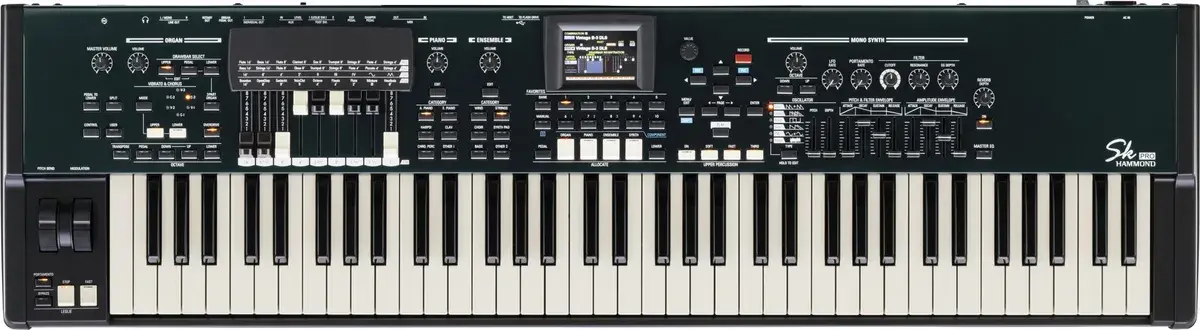
Hammond
SK Pro 73
Current- Keys
- 73
- Key action
- Waterfall
- Sections
- Organ, Piano, Electric piano, Synth, Sample playback
- Drawbars
- Physical
—2021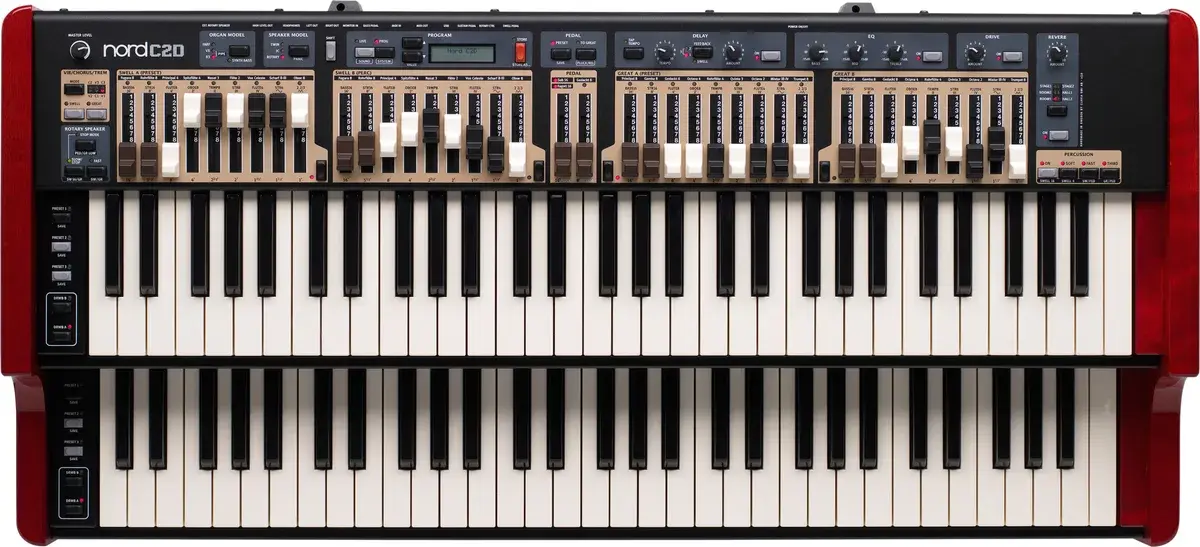

Arturia
V Collection 11 Pro
Current- Synth type
- Software collection
- Voices
- —
- Plugin formats
- VST2, VST3, AU, AAX
approx. £5222025