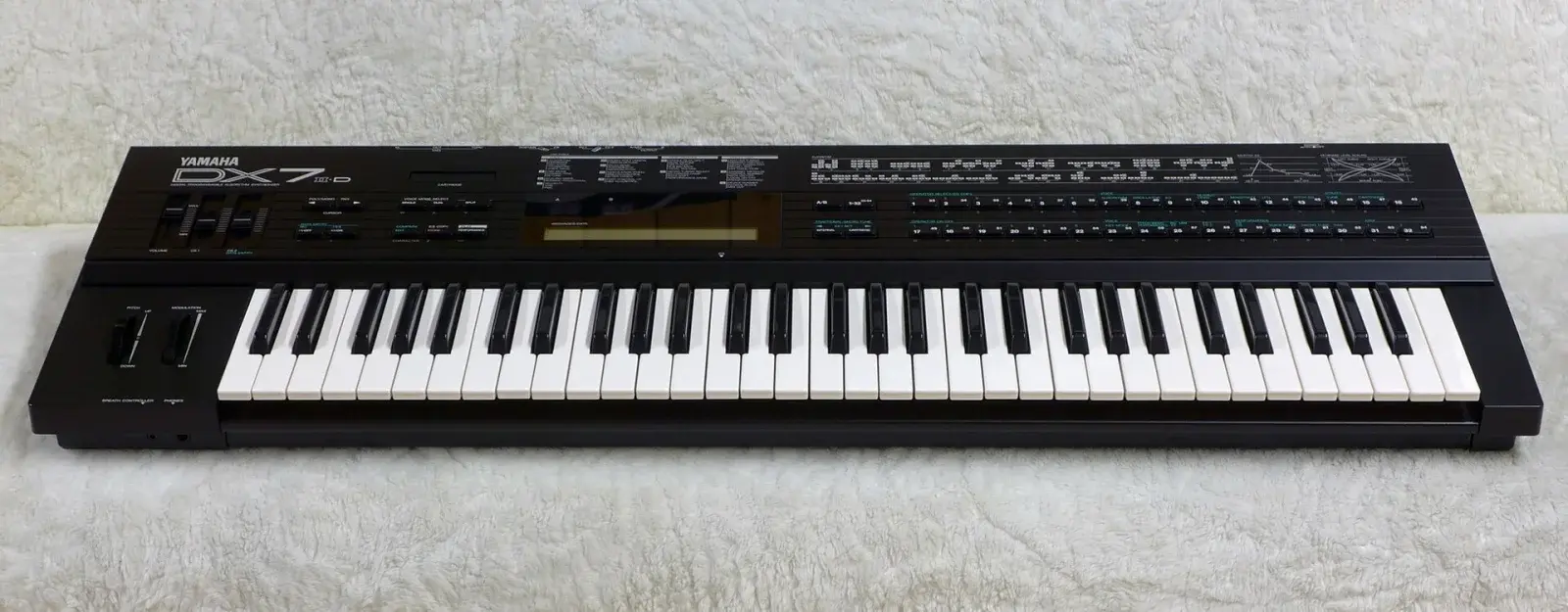
Photo: Leo-setä, CC BY 2.0, via Wikimedia Commons, resized.

Yamaha DX7
LegacyReleased 1983
The synth that defined the mid-1980s: FM synthesis from Stanford's patent, six operators per voice and 16 voices in a keyboard that cost $1,995 in 1983, widely credited as the first synth to sell over 100,000. Almost impossible to program from its one data slider and two-line screen, so its factory presets (E.PIANO 1, BASS 1) ended up on a startling share of the decade's hits. The [DX7 sleeve note](/sleeve-notes/yamaha-dx7) has the full story and the records.
Replaced by DX7II
Specifications
General
- Manufacturer
- Yamaha
- Status
- Legacy
- Released
- 1983
Sound engine
- Engine
- Digital (FM)
- Voices
- 16
- Polyphony
- 16 voices
- Oscillators
- 6 sine-wave operators per voice, 32 algorithms
- Filter
- None
- Multi-timbral parts
- 1
- Sequencer
- None
Keyboard
- Keys
- 61
- Key size
- Full
- Key action
- Synth-action
- Aftertouch
- Channel
Format
- Format
- Keyboard
- Features
- 32 internal memories, ROM and RAM cartridges, Two custom FM chips, Membrane buttons, one data slider, 2 × 16 character LCD, Breath controller input
Connections
- MIDI ports
- DIN in, DIN out, DIN thru
- CV / Gate
- No
Heard on
Artists and records that used it, as Yamaha tells it.
- Howard Jones, “What Is Love?”
- Tina Turner, “What's Love Got to Do with It”
- Prince and the Revolution, “When Doves Cry”
- Kool & the Gang, “Fresh”
- Kenny Loggins, “Danger Zone”
- Berlin, “Take My Breath Away”
- Brian Eno, “An Ending (Ascent)”
- Angelo Badalamenti, “Twin Peaks Theme”